
Tennis adopted electronic line calling on clay and created a ball-mark monster

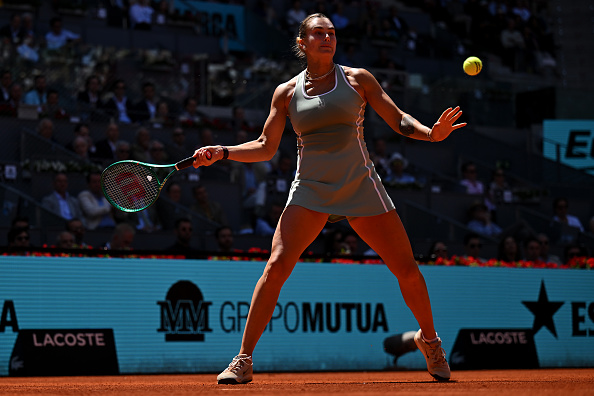
“Can you make it make sense?” Alex Eala asked after her defeat to Iga Świątek at the 2025 Madrid Open.Eala, the 20-year-old emerging talent from the Philippines, was not talking about her three-set loss, but rather a ball mark on the tournament’s red clay courts. Early in the match, Świątek hit a serve that the mark on the clay showed to be out, but no out call came: the electronic line calling (ELC) system determined it to be in.“I mean, the mark is the physical, it’s the physical proof,” Eala said.One year on, at the same tournament, it was Australian Open champion Elena Rybakina’s turn. Gesturing that a ball mark after a Zheng Qinwen serve was clearly out, she confronted the chair umpire.“This is not a joke. The system is wrong. This is not a joke. It is not touching. It is absolutely wrong,” Rybakina said before winning in three sets.“It’s kind of a stolen point. I understand it was her serve and she was serving really well, but it’s really frustrating,” she told reporters afterward.Rybakina and Eala were describing an increasingly regular occurrence for tennis stars on clay courts: being told not to believe their eyes. For decades, tennis events played on clay have relied on human line judges calling the bounce of the ball and chair umpires coming down to inspect the marks they leave in the red dirt. At some events, ELC has been introduced, and it is disagreeing with what the players can see.Some have even taken photos of the ball mark they believe proves their case. In Madrid last year, No. 1 seed Alexander Zverev used his phone to take a photo of a trace after a shot he believed to be out from Alejandro Davidovich Fokina was ruled in. Women’s world No. 1 Aryna Sabalenka did the same thing a week earlier in Stuttgart, Germany, this time to document a shot she believed was in but had been ruled out. At that event, ELC was not installed, with Sabalenka disagreeing with a line judge’s call. Both players received code violations for unsportsmanlike conduct.In Madrid, Zverev insisted in his post-match news conference that there was a “defect in the system” at that moment.“I will talk to the supervisors, I will talk to the ATP because, as I said, this is not normal. For a mistake to happen like this, yes, one or two millimeters I understand, but four, five centimeters is not normal.”With the bounce of a ball, tennis finds itself in a quandary that cuts to the heart of how people experience the world. When two different knowledge systems disagree with each other, which one should they believe?As of 2026, Hawk-Eye ELC is used at three of the four Grand Slams and across all men’s and women’s tour events above 250 level, including the Madrid Open. The Australian Open replaced line judges with the system in 2021, as did the U.S. Open in 2022. Wimbledon followed suit last year. The French Open has retained line judges, continuing to use ball marks left in the clay to determine whether shots are in or out.Tennis balls leave marks on all surfaces, but they are practically invisible to the naked eye on hard and grass courts, although on grass, chalk can sometimes fly up if a ball lands on or close to a line. On clay, visible traces can create tension as two systems disagree with each other.ELC has a margin of error of a few millimeters but ball marks on clay can be illusory. It is a “live” surface, affected by the amount of red brick dust in different parts of the court, weather conditions and the shot’s trajectory. Tennis balls compress when they land, creating marks of all shapes and sizes that do not always tell an accurate story of the impact. Even systems billed as 100 percent accurate, like Foxtenn, which uses cameras to display the ball’s bounce, can be affected.Before the introduction of ELC on clay, the ATP, with some consultancy from the WTA, paid for and commissioned an introductory video designed to explain these illusions to players and spectators.ATP players were sent the video, and the WTA shared it on its channels and briefed its players about some of the quirks of ELC on clay, but that hasn’t stopped some of them from raging about perceived injustices, even a year later. Instead of showing the ball’s bounce at court level, television broadcasts still use the top-down Hawk-Eye replay that they do on grass and hard courts, which does not help players who can see a mark that does not match up.In Madrid last year, the ATP Tour’s X account even responded to a post about the Zverev incident from Tennis TV, a media entity that the ATP Tour owns. The ATP said it was unaware of any defect; Hawk-Eye did not respond to a request for comment.In other scenarios, players have tried to let the ball marks speak for themselves. Last year, two-time Grand Slam singles and mixed doubles champion Victoria Azarenka had a serve called long in a doubles match against Demi Schuurs and Asia Muhammad, but Schuurs and Muhammad referred to the ball mark and gave Azarenka a first serve.This kind of sporting behavior is acclaimed across tennis, but in this instance it has wider philosophical consequences for officiating. If ELC is determining whether a ball is in or out, then ball marks should not be used as part of any decision-making process. For players, that requires erasing years of muscle memory not from their strokes, but from their brains, by ignoring not just the evidence right in front of them but the knowledge system that they have relied on to understand their sport.This discrepancy has played out much longer for spectators. A high watermark for the introduction of ELC was the 2004 U.S. Open quarterfinal between Serena Williams and Jennifer Capriati. Williams had numerous shots called out that Hawk-Eye showed as clearly in — but the technology was only available to television viewers and was not used in the match.From 2007 to 2024, Wimbledon employed a Hawk-Eye challenge system, which was also used at the U.S. Open and Australian Open before line judges were dropped. Players could object to calls they disagreed with, but were only permitted three incorrect challenges, so they could not review every close call. Viewers would therefore see replays of balls called one way, which were in fact the other.In a sport that already poses so many mental challenges, it was inevitable that players would sometimes become frazzled when told that they can’t believe what their eyes are telling them — even if they have watched an educational video that explains how and why discrepancies might occur.In 2024, Zverev said umpires were to blame for his two Grand Slam final defeats in a general tirade during a match in Shanghai. During the decisive fifth set of that year’s French Open final, a second serve from Carlos Alcaraz was called out by a line judge, but the chair umpire came down and overruled. The Hawk-Eye television replay ruled it out — but within the circa 3mm margin of error for the technology.Certainty can be an illusion, especially when the logic at the heart of players’ arguments against ELC is that their eyes can track a small, yellow object moving at over 100mph better than a system designed to do only this.Taylor Fritz, the American world No. 4, said that there can be discrepancies in how well players can adjust based on their tennis background: “For someone like me, who’s not a clay-court player, stopping points and looking at marks mid-point, trying to see if it’s in or out, is so much tougher to do than someone who’s played on clay forever,” he told reporters last year in Madrid.“So I really like how we can just play until we hear the call. If we don’t hear the calls, we know we’re playing the point. There’s no grey area, and whether it might miss a call or not, I don’t care, at least it’s consistent.”Sabalenka, who queried a ball mark in Stuttgart, is in favor of ELC because it takes away the emotional element of an umpire not wanting to admit to a mistake. “When it’s a little mistake or not even a mistake, I prefer to have the Hawk-Eye system than the referee because sometimes referees can be very weak (and would rather not) go there and confirm that they made a mistake,” she told reporters.Prominent players Madison Keys, Alex de Minaur and Elina Svitolina agreed that while there will be frustrations with ELC, they don’t compare to the old dynamic of disagreeing with an umpire inspecting a mark.“I always hated when they came out and their fingers would swirl around,” Keys said in an interview last week.“This isn’t going to go how I want it to.”Fils has the opposite view.“We have to go back to the normal line judge and to believe in the umpire because now the umpire is not doing anything,” he told reporters in Madrid last year. Players have, in the past, railed just as much against umpires making their decisions based on what the players believe to be the wrong mark.With the discrepancy between ball marks and ELC manifesting on individual shots — and a tiny minority of the total points played across an event — it is as easy to forget that players are being asked to completely recalibrate their understanding of the sport. It might be hard for them to erase ball marks from their minds, even if they know they can be illusory.Świątek, who said after beating Eala that “there’s no point” for players to say whether they prefer ELC or umpires inspecting marks, appears to have found her version of acceptance.“You prefer to play with umpires, but you go on court and have electronic line calling?” she said in a news conference. “There is no time to have your mindset in that way, so I’m just going to accept whatever there is.”


Most Popular

.png)



Match 38: LSG vs KKR - Code of Conduct
8 hours ago