A man of two versions
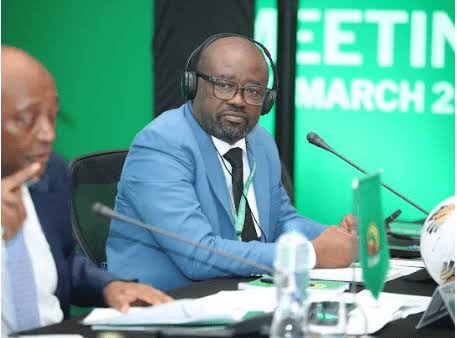
There are two versions of Kurt Edwin Simeon-Okraku, president of the Ghana Football Association (GFA).One is emotional, sometimes loud, and even theatrical. Those closer to him and have known him for many years say, he's a passionate man, and that sometimes he allows the passion to get the better of him.They may be right.If not, why would he walk to the dining room of the Black Stars, under the weight of failure and anger, spend 17 minutes rebuking the boys for drawing against Niger during a 2025 African Cup of Nations (AFCON) qualifier?Why would he take a microphone before global cameras and tell the world that a coach he hired to manage Ghana's senior national team was a trial and error technical brain.The other is quieter. Calculated. Strategic.When you listen to him, strategy is a word he uses often, and that word is the second version of him. A version that's less visible, less discussed by stakeholders and the media.Because while the senior national team, an embodiment of this country has stumbled through one of its most turbulent eras, failing miserably at every major tournament since he took over the reigns of Ghana football in October 2019, there appears to be deliberate pivot beneath the surface: Ghana has become a recurring host of youth football competitions.And that may not be accidental.GFA, under the 54-year-old, has consistently positioned Ghana as a destination for youth tournaments across the West African and continental space.Consider the pattern:WAFU Zone B U-17 Championship ( Cape Coast, June 2022)WAFU B U-20 Girls Championship (Kumasi, June 2023)WAFU Zone B U-17 Championship (Legon, May 2024)WAFU B Girls Championship (Ghanaman Soccer Centre of Excellence, December 2024)CAF African Schools Football Championship (Legon, April 2025)And now,CAF U-20 Africa Cup of Nations (2027 – scheduled)This is not a coincidence. It appears to be a policy. A policy to make Ghana a destination for youth football and, in the long-term, continental or even football.That very Monday, April 27, 2026, dawn, when Mr Okraku posted on his Facebook page, "2027 U-20 Boys AFCON to be Hosted by Ghana." I began to take a closer look at the trend.Ghana has hosted five youth tournaments in the last four years and will host the U-20 African Youth Championships for the first time in 27 years.It is a trend that appears to be deliberate.Hosting youth tournaments is often dismissed as low-stakes football administration. People hardly show up to watch unless you're a scout, then there's limited attention from the media, and sometimes modest or zero commercial returns. But in truth, it is one of the strategic plays in football development.You bid for youth tournaments not because they are glamorous but because they demand standards.Standards in infrastructure.Standards in logistics.Standards in administration.And each successful hosting becomes both a test and a justification for investment.CAF does not hand out hosting rights cheaply. Even youth competitions require minimum benchmarks: training pitches, match venues, accommodation, medical facilities, and media infrastructure.By repeatedly bringing these tournaments to Ghana, the FA has, whether subtly or intentionally, created pressure points.Pressure on facility owners.Pressure on local authorities.Pressure on government.It becomes harder to ignore infrastructure decay when international tournaments are scheduled on your doorstep.CAF might have seen a certain progress from previous youth tournaments hosted before handing the U-20 hosting baton to Ghana.This is where Okraku’s intelligence shows.He understands that in a system where direct state-led infrastructure investment is slow, sometimes the best lever is obligation to force improvement by committing the country to international expectations.Oftentimes, the infrastructure of Morocco is praised, but many lose sight of the fact that their decision to consistently host competitions meant that they had to invest in every aspect to meet standards.Today, Morocco stands as one of Africa’s premier football infrastructure hubs: AFCON 2025 continues to be measuring rods for other hosts.Ivorian Journalist Mamadou Gaye, at a press conference in January 2026, said Morocco has raised the bar so high that taking the tournament to any other country is a downgrade.The North African country has placed itself in a position for bigger stages, including the FIFA World Cup.They did not arrive there overnight.They built it, tournament by tournament.Ghana, under Okraku, appears to be attempting a similar path.Ghana's decision host AFCON 2008 still serves the country in a great way. The country hosted WAFU 2017 at the Cape Coast stadium, but since then, hardly had the country earned the favour of CAF to host any competition until Mr Okraku stepped up.When he did, a steady stream of tournaments began to flow through Accra, Cape Coast, Kumasi, and even Ghanaman Soccer Centre of Excellence, the technical centre of the association.However, the everyday reality of Ghana’s football infrastructure remains deeply troubling.Many facilities are still in deplorable condition.Maintenance culture remains weak. Investment is inconsistent.Upgrades often appear cosmetic rather than structural.So the question naturally arises: if the strategy is sound, why is the impact uneven?It must be said plainly: Kurt Okraku has been smart. Not perfect. Not beyond criticism. Just smart.I am not his cheerleader or even a part of it, but I will be dishonest if I do not acknowledge this.For the avoidance of doubt, I have written great pieces about his tenure, but I have also written some uncomfortable ones from his perspective, one of them has his administration dragging me to court over a procurement-related claim I inadvertently made and later apologised for.That legal battle still lingers in the background.But fairness demands honesty.Dragging a journalist to court does not erase good decisions, and it doesn't mean those good decisions shouldn't be covered with same energy.And recognising good decisions does not erase flaws.Both can exist.If both can exist, it must be said that the cleverness behind hosting youth tournaments has limits. Infrastructure does not sustain itself.Facilities do not maintain themselves. Strategy without state backing eventually stalls. This is where the government must step in not as a passive observer but as an active partner. Because if the FA is creating the opportunities, then the state must secure the legacy.Without that alignment, Ghana risks becoming a host nation without becoming a football destination.Ghanaians may not forget the worst period in recent Black Stars history.The revolving door of coaches. The declining FIFA rankings, the ban U-17 girls suffered, the hooliganism and insecurity in the Ghana Premier League, and other competitions under umbrella of the FA, but it will be disingenuous for even his critics not to appreciate that there's an expansion and visibility of youth and women's football, and of course, some good moments.Out of the $19m due Ghana from the FIFA Forward programme in the last 10 years, GFA accessed $16m of that. It takes a certain tactic to be able to get FIFA to release such humongous amount to a member federation.We can question the impact of that money on the football ecosystem, especially where the 83 pitches can be located, but we can not deny his level of management.Few leaders embody such duality so completely.There is a temptation to judge football leadership only through the senior national team.That would be too simplistic.Because long after the anger of failed AFCON campaigns fades, what remains are structures pitches, academies, and systems.If Ghana fully leverages this youth-hosting strategy, the long-term gains could be profound.If it does not, these tournaments will become fleeting moments; events without legacy.


Most Popular