Ben Ainslie exclusive: “You go looking for what’s next” - Olympic sailing legend on his London Marathon debut
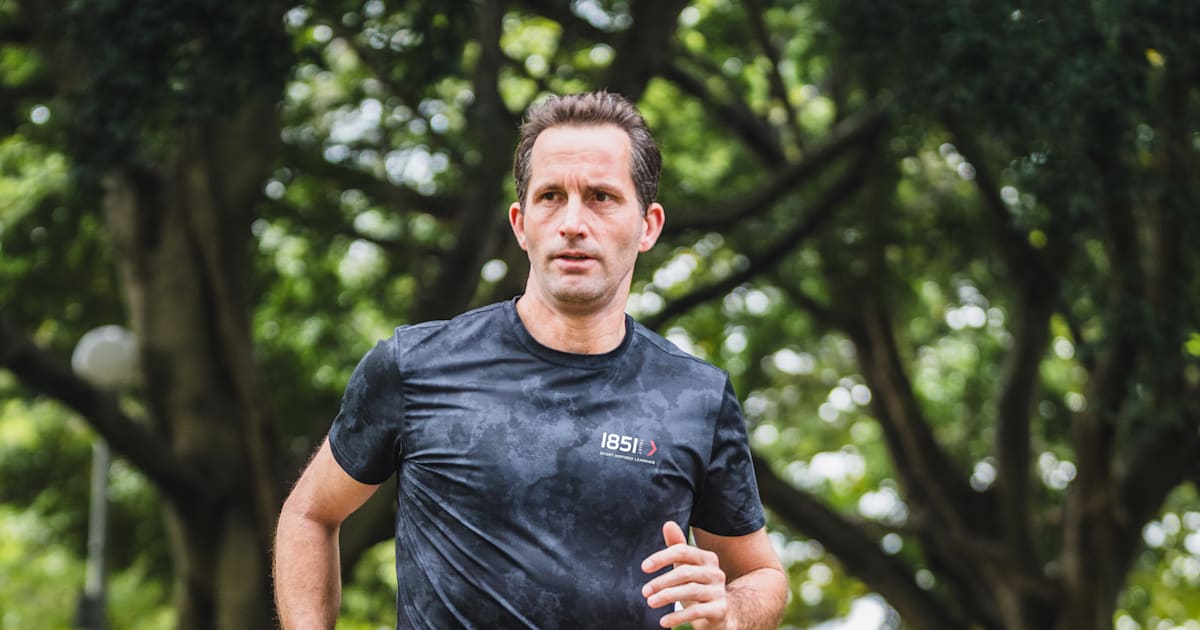
For close to two decades, Sir Ben Ainslie built one of the most successful sailing careers in Olympic history.But on 26 April, the Brit will face a very different test when he makes his London Marathon debut, taking on one of the most iconic running races in support of the 1851 Trust.Ainslie is no stranger to pushing his body to the limit, but this endeavour comes with a different kind of uncertainty. In an interview with Olympics.com, the four-time Olympic champion reflects on life beyond elite competition, the demands of marathon training, and why this latest chapter is about far more than simply reaching the finish line.A new race, a familiar driveFor Ainslie, the appeal of the London Marathon, one of the largest events in world sport, isn't hard to understand."It’s something I’ve always had in the back of my mind,” Ainslie told Olympics.com. “I’m a sports lover, so I’ve watched the marathon on telly a number of times and spoken to friends who’ve competed. I always thought it would be a really cool challenge to take on.”Until now, the timing had never quite aligned. The demands of Olympic sailing, the America’s Cup and SailGP left little room for marathon training, but with a pause in his racing schedule, the 49-year-old has finally found space to give the marathon a go.“I’ve stepped away from the competitive side at the moment — not fully into retirement mode, if that makes sense,” he said. “I haven’t been racing for the last 18 months, and to a certain extent, this is filling that competitive void.“I think a lot of sportspeople say this when they start stepping back from their competitive life: you go looking for what’s next. This has been a great focus for me in that transition.”Learning to pace the unknownIf the marathon appealed because of its scale, the training fascinated him for a different reason.Ainslie admits he started out expecting little more than a diet of long, steady runs. Instead, he found a programme built around far more than endurance alone: strength work, intervals, sprint sessions and the kind of detail that has given him a fresh appreciation for the sports science behind distance running.“I thought initially it would be much longer-duration running,” he said. “I hadn’t really expected the strength training, the interval training, the sprint training. But once you start doing it, it all makes sense.”That's a sharp contrast with much of the training that shaped his sailing career. In the Finn class, where he won three of his four Olympic gold medals, body mass and specific strength were central to performance. Marathon preparation has demanded a broader aerobic range, and with it a different relationship with effort.It's also delivered a few difficult lessons.Ainslie recalled one session in Fremantle, Australia, when he set out for a run while heavily jet-lagged and in punishing heat. He ended up stopping altogether.“I completely blew up,” he said. “It’s rare that I’ve actually had to stop running, but I literally had to stop. I felt like I was just about to explode.”Another run, this time in the Middle East while battling a cold, was equally grim. Both experiences reinforced the same point: marathon training may look simple from a distance, but it becomes unforgiving when travel, illness, and fatigue are layered on top of the schedule.His biggest uncertainty, though, remains race-day pacing. The longest run of his build-up reached 30km, offering a warning about what can happen when ambition gets ahead of judgement.“I think I probably went out too hard,” he said. “I was really paying for it from about 20 kilometres in.”Why London mattersFor all the unknowns, Ainslie knows there's nowhere he'd rather tackle a first marathon than London.“I’m a very proud Brit,” he said. “If I was ever running a marathon, it would be the London Marathon.”The route itself is part of the attraction. Like countless first-time runners before him, he's already heard about the lift of Tower Bridge and the emotion of the closing miles past Westminster, Buckingham Palace and into The Mall.More than that, London carries its own place in his sporting memory. It's the city where he won his fourth Olympic gold medal at the London 2012 Games, in front of a home crowd, and where some of the defining moments of his career played out.“London has played such a big role in my sporting life,” he said. “[I've got] so many great memories of the city.”The 1851 TrustAinslie says the idea for the 1851 Trust grew out of his experience in elite sailing, particularly when his America’s Cup team began looking for young engineering talent in Britain and found the pipeline thinner than expected.“When we started the America’s Cup team in 2014, we were hiring engineers and wanted to bring in younger engineers,” he said. “We really struggled to find that resource in the UK.”The Trust was designed to help close that gap by using sport to make STEM subjects feel more immediate and accessible. Ainslie knows that struggle personally. By his own admission, science and maths were not the subjects that most appealed to him at school. Only later, as sailing became more technical, did he fully understand how central they were to the career he was building.“When you can relate it to how a football spins through the air to curl into a goal, or how an F1 car can accelerate, or how an 80-foot sailing boat can get up on a foil, then it suddenly gets a whole lot more interesting.”That's why, when Ainslie talks about success on Sunday, he's not speaking only in terms of a finishing time.Of course, getting across the line matters. So does judging the pace well enough to avoid the wall he knows may be waiting somewhere in the closing kilometres. But he also sees the marathon in a wider frame: as a way to test himself again, to learn a new sport from scratch, and to help a cause he believes can shape the next generation.“It’s as much about the journey, isn’t it?” he said. “Pushing yourself, meeting new people, learning something new — all of those things are as rewarding as actually getting across the finish line.”For one of Britain’s greatest Olympians, that may be the clearest measure of what this marathon means. It's not a return to the career that made him famous, but proof that the urge to stretch for something new hasn't gone anywhere.




Most Popular

UF Hopes 'Common Sense' Leads to Aberdeen Reunion
10 hours ago



Seed Tritons Set for Postseason Rematch
7 hours ago