J&K in sight of their wonderland - here's how they got here
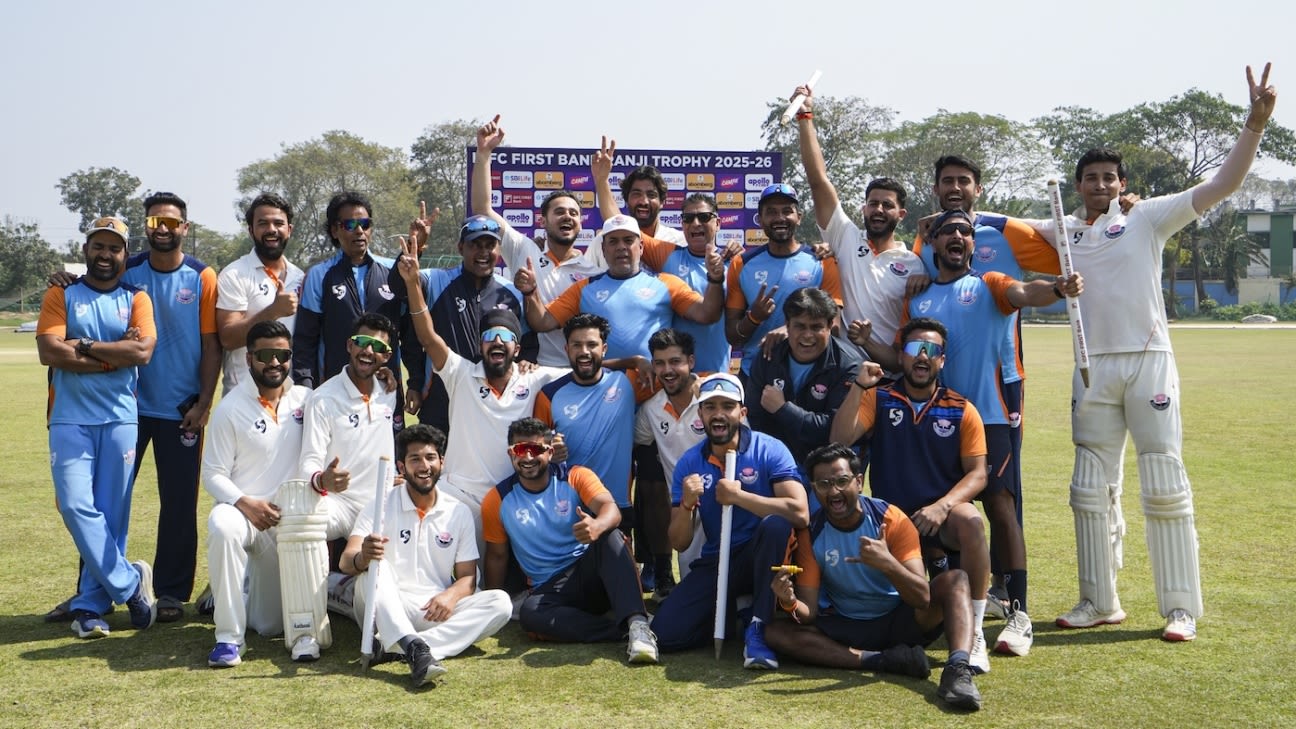
It has taken them 67 years to get here, and it has been far from easy, but with Ajay Sharma's back-room expertise and star performers led by Auqib Nabi, Jammu & Kashmir are one step away from historyShashank KishoreFeb 23, 2026, 9:29 AM • 6 hrs agoIn 2018-19, Auqib Nabi was a struggler, knocking on the doors of cricket clubs in Bengaluru because cricket hadn't taken him too far back home in Baramulla. A well-connected friend from Kuwait helped him secure a spot at Chintamani Club in Karnataka's second-division league. Nabi waited for his opportunity to break into the XI. When he finally did, he played as a lower-order batter.Eight years on, Nabi is the toast of Baramulla. No bowler has collected more wickets than his 99 across the last two seasons combined; 55 of those wickets have come in the 2025-26 Ranji Trophy season alone. In last week's semi-final against Bengal, he took nine wickets to lead Jammu & Kashmir to victory after they had conceded the first-innings lead.As he stands on the cusp of a potential J&K fairy-tale - their maiden Ranji Trophy title - Nabi is no longer knocking on doors. At the IPL auction, Delhi Capitals outbid three franchises, and when the paddle came down, Nabi was signed for 28 times his base price, selling for INR 8.4 crore.RelatedJ&K eye history, Karnataka chase ninth Ranji titleNabi and Samad star as J&K book spot in Ranji Trophy final'My goal is to wear the India whites' - Auqib NabiJ&K look at new frontiers, with luck and solid planningIn many ways, Nabi mirrors J&K's rise as a cricket force. From looking for recognition, they are near the peak of Indian domestic cricket.Coach Ajay Sharma and captain Paras Dogra haven't received so many interview requests from journalists, ever. Not even when J&K beat Mumbai in Mumbai in 2024-25. Not after they made the quarter-finals or semi-finals this season. But the past week has been frenetic.Everyone - from the who's who of J&K politics to senior administrators, from former cricketers to the current crop - is rooting for the side. Until last season, they can't recall sitting for more than two interviews. Now, they are fielding that many every hour."We've gone from being party spoilers to title contenders," former captain Samiullah Beigh says. "It's as if we're now the neutrals' favourite. It's great to have that support," adds a Jammu & Kashmir Cricket Association (JKCA) official.And they have gotten here the hard way: beating Delhi in Delhi, beating Madhya Pradesh in Indore and Bengal in Kalyani. It all started in October with a dream: to beat Mumbai for a second consecutive time. They fell agonisingly short in Srinagar. While the "hurt of not winning" motivated Nabi, Sharma says J&K took the field as equals, looking Mumbai "eye to eye" after being buoyed by their win the previous season."I hadn't seen that earlier," he says.And so, here they are, 67 years after their first appearance in the Ranji Trophy, on the verge of making history as they take on Karnataka - eight-time champions but chasing their first title in a decade - in Hubballi.****Sharma was on a family holiday in Thailand in mid-2022 when his phone rang. On the line was current BCCI president Mithun Manhas, his former team-mate and then head of cricket development in J&K. Sharma had coached Delhi's age-group sides with decent success. He had been a catalyst in Yash Dhull's rise from the age-groups to the India Under-19 captaincy.Naturally, he nurtured ambitions of graduating to the senior Delhi team. When that didn't happen - Sharma cites his court battles in the match-fixing case as one of the reasons - he decided to take up what came his way. "Honestly, I wasn't keen on joining," Sharma says. "But with Delhi, I was going nowhere. Maybe the court cases were a hindrance even though I was cleared. So I took up the J&K offer after Mithun convinced me."Sharma's early days at J&K were turbulent. He quickly sensed a divide between the team's IPL players and the rest of the squad, and he made it clear he wanted to dismantle any trace of "star culture".The move did not go down well. A group of players wrote to the court-appointed committee, headed by Brigadier Anil Gupta, complaining about Sharma's methods. Sensing the situation could spiral downwards, the committee advised Sharma to soften his approach.Sharma did, but he hasn't forgotten what had happened."I still have those letters," he says with a laugh. "They thought I was a dictator. While I didn't change my coaching methods, I learnt to communicate the way they liked."On his first day in charge, when Sharma asked all the players about their achievements and goals, he was startled to see a pattern. "They were celebrating being IPL net bowlers," he says. "If they earned a trial, they wore it as a badge of honour. That survival attitude wasn't good enough. We needed to change it."These changes didn't happen overnight. It developed over a three-year period - a rare luxury for coaches, especially in J&K, an association long riddled with administrative issues."Credit goes to Manhas and his team for giving me that rope," Sharma says. "When you work with a side for that long, it starts to feel like home. You build understanding. You build bonds."The players understand these things [focus on discipline], sometimes even get angry, but it's all for their own good. We're like friends now. When we come to the ground, we don't leave for six hours. Whatever they do afterward, whether they roam around or go somewhere, that's their business; we have no problem with it. But when they arrive in the morning, they have to be prepared and disciplined.""His commitment to fitness has sparked a transformation within the group. He can compete even with the Under-19 kids, probably even beat them when it comes to fitness. Even at 42, he wants to keep batting and perfect his craft"Ajay Sharma on Paras Dogra, the captainThe defining moment of Sharma's tenure came more than two years after he took charge, at Mumbai airport last season when former India and Tamil Nadu quick bowler L Balaji spotted him and greeted him warmly, calling him the "father of centuries".The players looked puzzled. Within seconds, phones were whipped out. A quick search revealed what many hadn't known: Sharma averaged 68 in 129 first-class matches and had scored 38 centuries in the format. "They realised then who their head coach was," a JKCA official says.J&K batted with the "confidence of centurions even though no one made a century," the official says with a laugh, as they went on to beat Mumbai in Mumbai in the next game. The match began with hoopla surrounding Rohit Sharma's return to the Ranji Trophy - it would eventually be his last first-class match - but ended with J&K having toppled the 42-time champions.That win sparked change elsewhere.It gave JKCA the push to prepare surfaces that aid fast bowlers and help batters better equip themselves against bounce. They built the state's first red-soil surface at the Sher-i-Kashmir Stadium prior to this season.However, in a twist, Mumbai returned the favour in the 2025-26 season-opener on the same kind of surface J&K had prepared to counter them. But the 35-run loss was merely a stepping stone.****The win against Mumbai in the 2024-25 Ranji Trophy had sparked joy. But once the dust settled, Sharma made a strong statement ahead of their next league fixture against Baroda."I dropped Abdul Samad for the next game," he says. "That boy bats so cleanly. I've never seen someone time the ball better than him in the four years I've been here. He is unbelievable, hugely talented. And yet, when I see him recklessly try and hit out against spin and get stumped, just because the bowlers have messed with him, it pains me."Samad is his own enemy. His mindset was, 'I want to be a gun IPL player'. He had to be told, 'if you win a Ranji title for J&K, you will be a star automatically'. His manner of dismissals pained me no end. By dropping him, I sent that message out to the group. And they realised, if Samad can be dropped, anyone could be."There's been noticeable change in the Samad this season. While he has still, in Sharma's words, "missed four centuries", he still tops their run charts with 655 runs in 13 innings at an average of 59.54.Nabi and Samad are just two of several players who have taken a while to bloom.Fast bowler Yudhvir Singh Charak made his debut for Hyderabad in 2019, and moved back to his roots in J&K in 2021. Although he has played for Lucknow Super Giants and Rajasthan Royals in the IPL, the confidence to be a match-winner has only come recently, after starring in last year's Mumbai win."That mindset to become someone who can win us even if Nabi isn't there has come after that"Ajay Sharma on Yudhvir Singh"Until then he was a support bowler," Sharma says. "That mindset to become someone who can win us even if Nabi isn't there has come after that. Today, Nabi, Yudhvir and Sunil Kumar are as good a pace attack as any in India."Sunil, a left-arm seamer, was picked from a talent hunt two years ago, and straightaway drafted into the list of probables. He hadn't received formal coaching until he was 25. Here he is, three years on, having played a key role for J&K. He took 7 for 68 in the semi-final, and a crucial three-for in the quarter-final, against Madhya Pradesh, which helped open up a lead and eventually secure victory."We initially identified him as a white-ball prospect, but the skills he showed in the nets and his attitude convinced us we had something to work with," Sharma says. "And Sunil has proved us right."Then there's Sahil Lotra, an offspinner, who made the North Zone squad for the Duleep Trophy but hasn't become a regular this season for J&K only because of their impetus on lower-order depth."Our batting relies on Samad, Paras Dogra and Shubham Khajuria," Sharma says. "That has forced us to strengthen our batting at every available opportunity. That's where Vanshaj Sharma has made a massive difference."Vanshaj's potential was discovered by accident. When they sent him as a nightwatcher against Delhi. "He scored eight runs, but blunted 60 deliveries at No. 4. His role was key to us successfully chasing 179. That stonewalling helped Qamran Iqbal, who made 133 not out."Two months later at the Vijay Hazare Trophy, Vanshaj again proved his batting capabilities by helping J&K win from an improbable situation. Reduced to 90 for 7 in a chase of 269 against Hyderabad, Vanshaj and Nabi put on 182 for the eighth wicket to seal victory.While focusing on individuals has been a massive part of their campaign, they haven't had to look too far beyond the dressing room for inspiration. Dogra was brought in as captain three seasons ago as a professional, after more than two decades in first-class cricket, largely with Himachal Pradesh.In the semi-final, Dogra became only the second player in Ranji history - after Wasim Jaffer - to scale the 10,000-run mark. He hasn't had a prolific season, but his doughty efforts have combined to produce 551 runs in 14 innings at an average of 42.38, a contribution that can't be undermined."His commitment to fitness has sparked a transformation within the group," Sharma says of his captain. "He can compete even with the Under-19 kids, probably even beat them when it comes to fitness. Even at 42, he wants to keep batting and perfect his craft. He brings calmness to the group. He's a mature leader, and his hunger to perform even at this age is commendable."On the brink of history in Hubballi, there is quiet conviction in the J&K camp. From knocking on doors to knocking over giants, their journey has been built on resilience, reinvention and togetherness. Whatever the result against Karnataka, this much is certain: J&K are no longer hopeful and ambitious outsiders. They belong.Shashank Kishore is a senior correspondent at ESPNcricinfo



Most Popular

Matt Walker Hired as Drake's Head Football Coach
18 hours ago



Venables Hires Assistant Coaches McCullough, Morgan
20 hours ago