A first-class season of the Plunket Shield
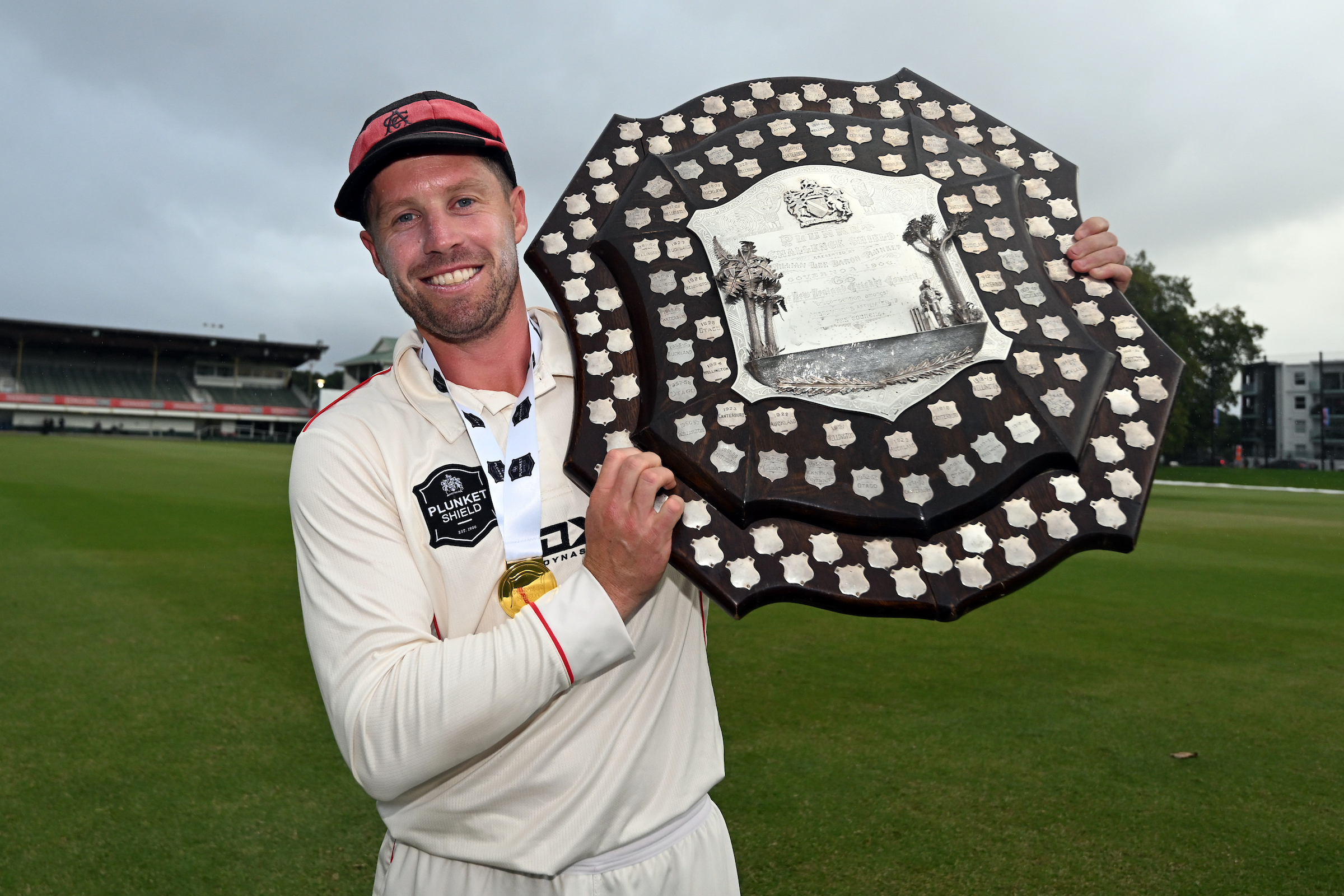
Plunket Shield champion Canterbury finished the 2025/26 season just a fingertip away from an elusive feat in New Zealand men’s Domestic cricket history — the triple crown.The team finished runner-up to the Central Stags in a remarkably high-scoring one-day Ford Trophy Grand Final, and were denied by Northern Brave in the summer’s T20 Super Smash Grand Final.But lifting the first-class Plunket Shield in the 100th edition of the national championship is far more than a consolation prize, says captain Henry Nicholls.“For us and, I think for most teams, it is the pinnacle,” Nicholls said as the century-old, ornate silver shield was carried proudly into the Canterbury dressing room.“It’s the hardest format, and we know how much hard work goes into it.“I felt like we played so much good cricket this year, we deserve to have something to show for it — and for it to be the last day of the season and to see the shield there, it’s a reflection of the hard work.”Nicholls led from the front as the top first-class run-scorer this season: 870 runs at a heady 99.66 average, three centuries and five half centuries among his 11 innings in a dream summer. He finished a full 153 runs clear of Central Stag Brad Schmulian.But Nicholls was the top Ford Trophy run-scorer, too (588 runs from 10 innings, four centuries including 115 in the Grand Final) yet he had walked away empty-handed.He’s grateful to now have a tangible marker of a special season, personally, and with his impressive team.“Some guys like myself have won it a few times, but for the guys who haven’t, across our entire playing group, it's an incredibly special feeling.“The 12 guys who were here in Auckland got to enjoy the occasion but it certainly reaches further than that.“Even ‘Fults’ [ex-head coach Peter Fulton who left midseason to join Middlesex] who isn't here, he played a massive part in shaping the team and mindset that we have today.“The success is a credit to so many people within the organisation in Canterbury and we've played a lot of good cricket,” said Nicholls.“We’ve been resilient to bounce back from the disappointments, so to have something to show for it really means a lot.”Rhys Mariu, who helped power Canterbury to the vital full set of batting bonus points in Auckland with his first innings 142 (Leo Carter also going big with an unbeaten 169* in the highest team total of the season, 591) said the mentality of the Canterbury group was a major factor in their success.“It was obviously a long four days, hot weather, off and on with rain, and we already had the Plunket Shield won, but we wanted to get a win to cap it off,” said Mariu.The whole season we bought into the team-first mentality and I think we epitomised that by fighting on to try to push our points even further up there.“I think that mentality will have a lasting effect on us, not just this season. “It was obviously a disappointment to lose those two finals, but to keep up the fight for this — it’s just a great environment and mentality that Fults instilled, and it shows that it's paying off when we're winning titles.”Canterbury was the original holder of the Plunket Shield when it was first presented, as a challenge match trophy, in 1906/07. It became a multi-team championship in 1921/22, and this summer’s title was Canterbury’s 21st.It brings them closer to catching the record of Auckland (24) and Wellington (22) — the latter finishing with a wooden spoon this summer.Canterbury takes the Shield off Northern Districts’ hands, but all three of last season’s men’s Domestic trophy champions were the winners again this season, just in different formats.Northern (as Northern Brave, their T20 moniker) lifted the Super Smash trophy. The Central Stags won last year’s Super Smash and this year’s Ford Trophy. Canterbury wins the Plunket Shield, but was denied a Ford Trophy threepeat.With Northern Districts women winning their maiden Domestic title this season in the one-day Hallyburton Johnstone Shield, and Wellington Blaze nailing a Super Smash threepeat, only Otago is left with an empty trophy cabinet.Yet rejuvenated Otago was one of the revelations of the tightest first-class season in years.They were in the Plunket Shield fight almost to the end, one of four remaining contenders heading into the decisive eighth round, and can be consoled by Max Chu finishing as the leading wicket-taker with 40 dismissals from 15 innings.Otago’s four-wicket victory over the Wellington Firebirds this week was also the first time they had won three outrights back-to-back since 2012/13, and swept them to equal points with Canterbury (99).At the end, Otago had the same number of wins in the first countback (four) after Canterbury’s long-winded drawn game with the Auckland Aces.That meant the Plunket Shield would be decided by net runs per wicket average, a calculation that had Canterbury home and hosed after their strong all-round form across the season.They had lost only one match, thumped by the Stags in a third-round blip in Napier; while both their matches against Otago had ended in draws.Had Otago picked up just one first innings batting bonus point in Dunedin — in the last match, the Shield would have been on a plane to University of Otago Oval for the first time since 1988.But that was not to be, and Canterbury’s net runs per wicket calculation ('RPW For' minus 'RPW Against' over the whole competition) was a hefty 12.134, making Otago the official runner-up with 5.134.Teams knew that scenario heading into the last round and, once first innings points were completed at all venues, it was Canterbury’s name on the trophy, as long as they avoided any penalties.Had they not copped a one-point penalty for a slow over rate earlier in the season, countbacks would not even have been required.Even with the knowledge that the Shield was secured (after having taken sufficient first innings bonus points), Nicholls said that he and his side still wanted to press on for a win on the last day.The Auckland Aces weren’t having a bar of it and, after a Dale Phillips century, pressed on to a small overall lead on a stop-start autumn day that had been punctuated by both rain and bad light.“We’re always playing to win and that’s just an extension of the team-first mentality that we have developed,” Nicholls explained.“I think if you look across the numbers of all of our players, everyone's had a really good season, everyone's put their hand up.“I've certainly enjoyed the captaincy side of things this year, and I'm very lucky with the group that I've had that we're always competing — no matter which players are in the mix.“So, it's really cool now to have something to show for a season in which we've played a lot of good cricket. It means a lot, not just to myself, but to all of us.”The Aces and Northern had been the other two live contenders, with Otago and Canterbury. Northern hosted the Stags in Hamilton where a thriller played out in the final session — an aggressive Robbie O’Donnell century giving ND a chance of a consolation victory, particularly after fading light meant the Stags could bowl only spin.But the Stags’ spinners, Ajaz Patel and Brad Schmulian, got the job done and, even though they had dropped out of contention for the title after their seventh-round loss to Canterbury, Central rocketed back up to finish third of the six teams.Central could reflect on a season in which opening pace bowler Brett Randell achieved a first-class cricket world-first five wickets in five balls against ND in Napier, in round six.Randell’s opening partner, left-armer Ray Toole, meanwhile put in a late run to finish as the Plunket Shield season’s top wicket-taker for the first time: 35 victims at 23.57, including two five-wicket bags and, on the final day of the season, his 150th first-class wicket in a 48-match career.Toole had been responsible for the Stags lifting the Plunket Shield in 2023 with a career-best 7/57 against the Aces on the final day that season — the Stags pipping Canterbury on a number of wins countback.He says refining his action has led to more consistent rewards.“I’ve done a lot of work, breaking down my action, and it just kind of clicked in this back half [of the Plunket Shield] in particular,” says Toole.“I’d felt like I’d hit a bit of rhythm just as the one-dayers were finishing, as we headed into The Ford Trophy final; and then in the prep for the first four-dayer of the back half.“My rhythm picked up from there, from that second innings in particular against the Firebirds, and then with a quick turnaround I just carried on that momentum.”Toole said the intense hunt for this season’s Plunket Shield championship showed why first-class cricket holds a special place for cricketers.“There were no real dead rubbers and it was awesome for first-class cricket, especially for Otago.“It was a great effort by them, the way they finished their season, and obviously for Canterbury who put the icing on their cake.“It was tough for us when we lost to them last week [in Rangiora], knowing that we were out of the race.“It hurt, as we’d played a lot of good cricket.“There were missed opportunities, but there was still one good opportunity for us to get back up the table — and as our last game progressed, we just tried to make sure we would finish on a high.“So it was certainly nervous times watching Robbie O’Donnell smacking sixes around Seddon Park, ND racing towards their target at one stage — but a cracker at the end for us.“There was a bit of weather as well, that we kind of escaped, so it was all happening.“We often call Brad Schmulian a golden arm, and he's a guy that always wants the ball. You can always turn to him in a time of need, and he'll get you either one or three or four, and with the light — it got pretty dark towards the end, it was just brilliant to have his leg-spin from one end and of course Ajaz at the other.”Schmulian took 3/5 to win the game; Toole had finished with 3/42 in a season in which he and Randell led the attack.Usual spearhead Blair Tickner missed most of the campaign following his BLACKCAPS recall, dislocated shoulder on the Test field and subsequent ankle injury.Toole’s 150th first-class wicket (Bharat Popli, on the final afternoon of the season) has a story to it.“After the previous ND game (an innings victory in Napier in which he took 5/32 in the second innings), my dad messaged me from Australia where my mum and dad live to say I was only 13 wickets away from 150 first-class wickets.“I thought that was a bit of a tall ask, but it was a personal goal I’d had and was something cool to strive towards. The last day in Hamilton was my dad’s birthday and my parents were over from Melbourne to see it, so it was a special birthday gift for him, and for me as well, as it was nice that he was here to watch it.”Toole had overtaken Auckland left-arm spinner Rohit Gulati as the leading wicket-taker with a round to go, Gulati finishing fourth-equal on 27 wickets (he was 12th man in the last round), and ND spinner Tim Pringle (31) and Canterbury’s consistent Fraser Sheat (28) completing the top three.Nicholls and Schmulian (717 runs at 55.15 from 14 innings, with two centuries) were chased by 21-year old rising star Lachie Stackpole, the left-handed Auckland Ace finishing his season with 667 runs from 14 innings at 51.30, also with two centuries.Final points (number of wins)99 Canterbury (4)99 Otago (4)87 Central Stags (4)85 Auckland Aces (3)82 Northern Districts (3)42 Wellington Firebirds (0)Final round:Otago beat Wellington Firebirds by four wicketsCentral Stags beat Northern Districts by 25 runsCanterbury drew with the Auckland AcesNet Runs Per Wicket Average



Most Popular