‘Important Position’-Michael Carrick Names Key Transfer Objective for Man Utd
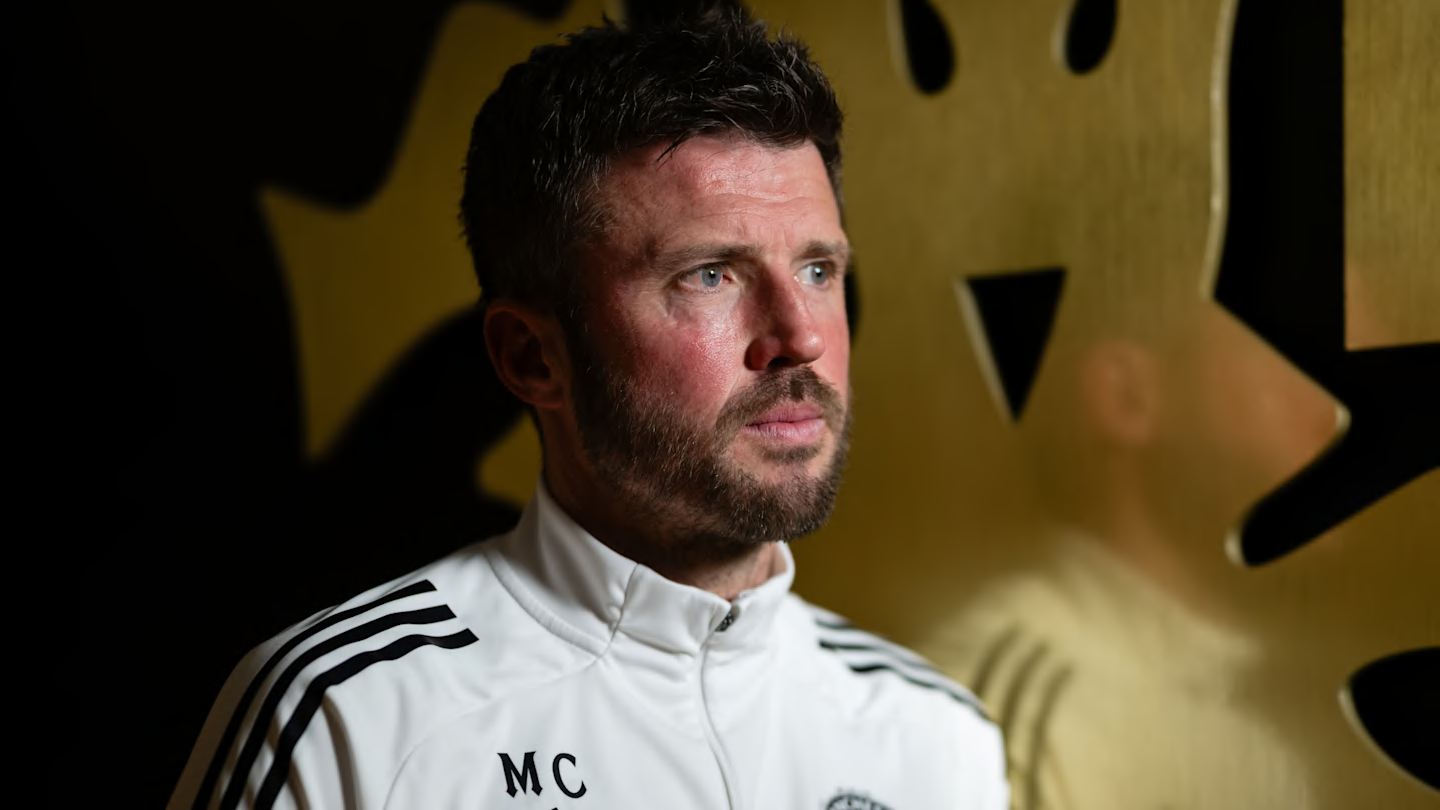
Manchester United manager Michael Carrick looked beyond his own personal situation to accept that the club will need to replace Casemiro and find a new player for that “important position” in defensive midfield.As a former operator from the middle of the park himself, Carrick is perfectly placed to let the recruitment department know how crucial it will be to plug the yawning chasm Casemiro leaves once his contract expires this summer. “Listen, it’s an important position, I think,” he told assembled media.“I’m not being biased, obviously, as being in midfield, but I think it is an important position to try and tie everything together, and you’re connected to the whole team, and that’s sometimes emotionally, a little bit mentally, and showing that composure and understanding of the game a little bit, and Cas has had a big influence within the group on that, so something we’re fully aware of moving forward for sure.”The likes of Crystal Palace’s Adam Wharton, Nottingham Forest’s all-action dynamo Elliot Anderson and Brighton & Hove Albion totem Carlos Baleba are thought to lie highest on the list of potential replacements. Whether Carrick will be in the dugout to oversee their introduction to the squad is another question entirely.Summer Window Is Biggest Test of Man Utd’s New ModelUnited’s current squad is a Frankenstein’s monster of past coaching ideals. The 24-man setup contains remnants from five different permanent managers and is being led by a sixth unique figure in the form of Carrick, whose own deal expires this summer.The defensive setup which Carrick deployed against West Ham United captures the issue: Goalkeeper Senne Lammens arrived under Ruben Amorim just last summer and lined up behind Diogo Dalot (bought by José Mourinho), Harry Maguire (Ole Gunnar Solskjær), Lisandro Martínez (Erik ten Hag) and Luke Shaw (Louis van Gaal). Five players for five managers with five wildly different styles of play.This is a chronic consequence of the modern obsession with hiring and firing managers. Clubs are all too happy to pull the trigger and appoint a different head coach who will demand an entirely new set of players. The assembly of an established hierarchy above the manager is supposed to prevent this confused accumulation.There’s some solid logic behind United’s push towards a sporting director model—that one figure removed from the dressing room and the fickle nature of relationships which plays such a large role in managerial turnover can oversee years of transfer windows with the same clear goal. Coaches are hired to fit the type of players already assembled, rather than the reverse. However, the meat grinder that is Manchester United makes a mockery of most seemingly sensible practices.Unfortunately for the Red Devils, Sir Jim Ratcliffe’s itchy trigger finger has led to upheaval at that level of the club as well—Dan Ashworth’s lauded arrival as sporting director last season lasted just five months and cost the club £4.1 million ($5.5 million).Director of football Jason Wilcox has since taken on the recruitment reins along with technical director Christopher Vivell. The pair oversaw a largely successful summer window—Bryan Mbeumo, Matheus Cunha and Lammens have all been clear wins while Benjamin Šeško has shown promising signs of coming good in recent weeks.A lack of European qualification prevented a midfield rebuild last summer (or in January) but the wider market trends have played into United’s hands this year.Man Utd Set to Benefit From Market TrendsThe transfer market tends to follow trends. In the immediate aftermath of a team unexpectedly performing well at a World Cup, players of that nation are given a transfer premium (subconsciously or otherwise) whether they featured in the squad or not. Just simply being attached to that success is enough to influence a highly volatile market.The same is true of positions. The past few windows have been dominated by players of a similar skillset, whose value is ramped up by their scarcity and the widespread demand. Summer 2025 was the off-season of strikers; six of the nine most expensive deals involved a centre forward. United are bound to the same fades as every other club—the Red Devils bought two of these costly forwards (Cunha and Šeško).Fortunately for United, the fervour for defensive midfielders appears to have faded.Data via Transfermarkt.This fascination for a player with perhaps the most unheralded role on the pitch peaked between the summers of 2022 and 2023. United, once again, played some part in this frenzy by paying £70 million for Casemiro four years ago. Enzo Fernández then definitively shattered the market with his record-breaking £106.8 million switch to Chelsea at the start of 2023. That summer saw the Blues and Arsenal break nine digits to sign Moisés Caicedo and Declan Rice respectively as prices soared.The subsequent two seasons have seen a retreat to normality, with average fees for central and defensive midfielders dropping. United are helped by the fact that many of their main rivals already have this area of the pitch sewn up; Arsenal, Chelsea, Liverpool and Manchester City boast some of the finest central operators on the planet.Reigning European champions Paris Saint-Germain have the luxury of deploying both João Neves and Vitinha while Barcelona remain enamoured by the pairing of Pedri and Frenkie de Jong. United’s biggest competitor this summer will likely be Real Madrid—who are yet to replace Toni Kroos or Luka Modrić. The race is on.READ THE LATEST MAN UTD NEWS, TRANSFER RUMORS AND MORE



Most Popular




Matt Walker Hired as Drake's Head Football Coach
18 hours ago

Venables Hires Assistant Coaches McCullough, Morgan
20 hours ago