
Numero uno no more: Could India consider leaving Varun out for the final?
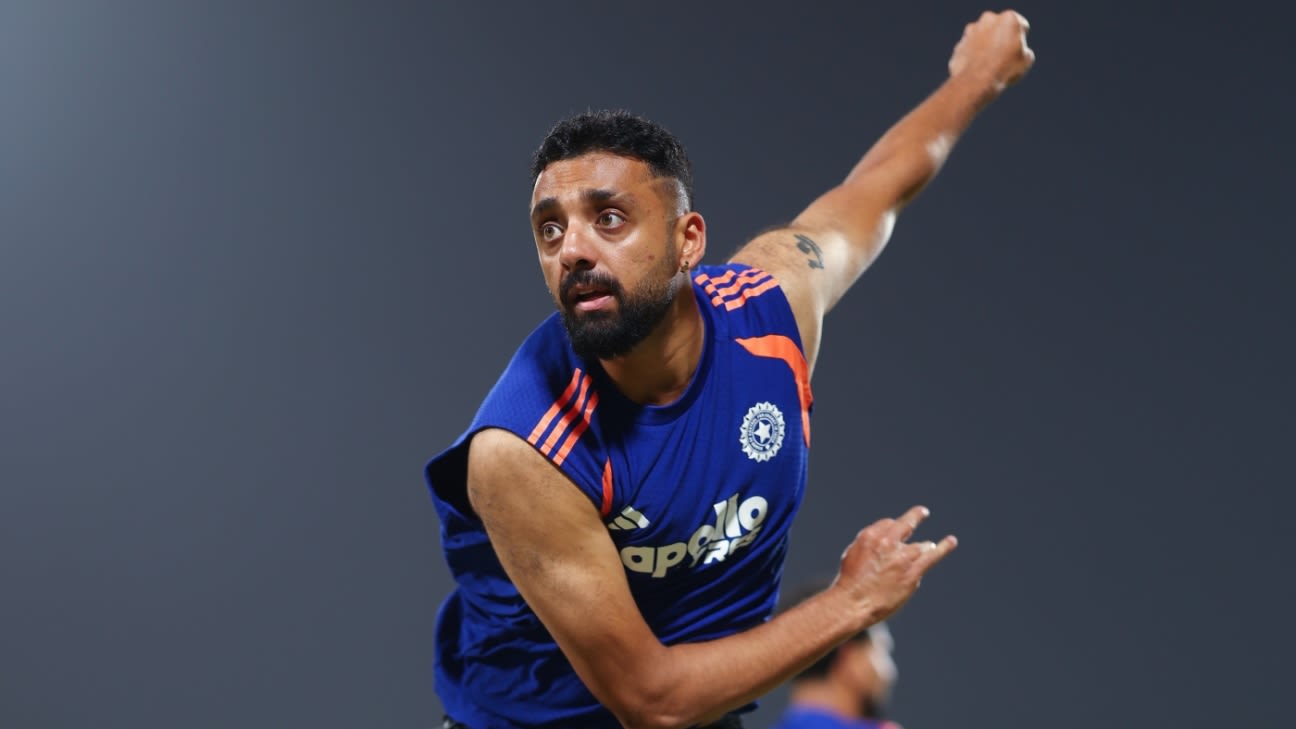
The India mysteryspinner is still the No. 1-ranked T20I bowler, but eight of his 11 most expensive spells have come in the last four monthsKarthik KrishnaswamyPublished: Mar 6, 2026, 3:30 PM (11 hrs ago)1:55Kumble: Varun's form a bit of a concernThe world's top-ranked T20I team is in the final of the T20 World Cup. They've got there with the world's top-ranked T20I batter and top-ranked T20I bowler enduring miserable tournaments. It's hard to find a clearer illustration of just how good India are, and just how deep their reserves of ability and experience run.But do they run so deep that India could contemplate leaving either Abhishek Sharma or Varun Chakravarthy out of their XI for Sunday's final against New Zealand? The question almost sounds heretical, but it is being asked, if only by those on the outside peering in.In one of the two players' cases, the answer is obvious and unequivocal. If he's fit, Abhishek remains one of the first names on the team sheet. In T20 cricket, you don't leave out a batter of Abhishek's quality and rarefied ceiling simply because he's made a string of low scores. Broadly speaking, he has taken the early risks you expect from a batter like him, and he's repeatedly fallen foul of the risk-reward coin. It could happen to anyone. The low scores, and potentially the lingering effects of the illness he suffered at the start of the tournament, appear to have affected the fluency of his shots and his certainty while playing them, but he remains a case of being out of runs rather than out of form.RelatedIndia's Death Star meets the Ewoks: Why offspin could decide the finalAre batters finding a new way to attack Varun Chakravarthy?There is no question of India even thinking of leaving Abhishek out. And even if they did, who would they bring in? Including Rinku Singh would necessitate shifting Ishan Kishan back to the opening slot and Tilak Varma back to No. 3, just when India have seemed to solve most of their early-tournament problems by moving Kishan to No. 3 and Tilak to an end-overs pace-hitting role.India are not leaving Abhishek out. No chance.There is a chance, however, that India could be discussing - even if merely to bring it up and dismiss it - the other question, the Varun question.Differentiating process from outcome is hard to do across the board in T20, but it's a little easier with bowlers. As much as batters move around the crease and find new ways to target unexpected areas, bowlers remain the instigators of every play. They have more controllables to control: the lines and lengths they bowl in accordance with the fields they set, the pace, trajectories and variations they employ.Sometimes you can do everything right by those measures and still get hit for six, and Varun knows this. His first ball in Thursday's semi-final against England was a pretty good ball - around the wicket, angling into the stumps to theoretically deny Jacob Bethell room, fired into the spinners' T20 good length to finish at a bail-trimming height. And Bethell hit it where you least expect a batter to hit that kind of ball; down the ground for six.The problem for Varun is that this has happened consistently through this World Cup, and over recent months, starting with India's five-match T20I series against South Africa in December. Eight of his 11 most expensive T20I spells have come in this time, and, as Sidharth Monga has pointed out here, he has been getting hit without necessarily bowling bad balls.In his press conference on the eve of the semi-final against England, India bowling coach Morne Morkel made an interesting observation about Varun. It's worth reproducing in full."With the skill and variation Varun's got, he's got the ability to take a wicket almost every ball. So if he goes for a boundary or if the ball he bowled is not executed as well as possible, for him it's [important] just to move on to the next one and make sure he commits to that next ball."He's a highly skillful guy, hard to pick once you walk in to the crease, so for him it's just about getting that confidence with the ball, getting his speeds, his length control right, and not try and overthink it."I think with Varun, at times - to his credit, he wants to be a big performer for the team, so he will put a little bit of pressure on himself, but he's a match-winner for us, and for him it's [important] to just stay and bowl every ball and make sure that's his best ball."The core issue seemed to be that Varun's best balls weren't looking particularly threatening. Batters around the world have struggled for years and years to pick him out of his hand. Watching England bat, it wasn't evident that they were picking him. But it almost didn't seem to matterMorkel seemed to be suggesting that Varun could be prone to dwelling on the outcome of his previous ball, and letting that affect his next ball. He seemed to do this on a few occasions against England, particularly during a bruising first over when Bethell hit him for three successive sixes. If the first six came off a reasonably good ball, the next one was off a genuine slot ball, the kind of ball Varun rarely bowls when things are going well for him.Coaches seldom worry about bowlers missing their execution - so long as it's infrequent - if they stick to their plans and bowl to their fields. But they worry when bowlers stray from their plans, because it tends to betray a lack of confidence or belief in their strengths in a given situation. It hampers their ability to recover from a bad start to an over, and minimise scorecard damage.Through that first over, and through his entire evening with the ball, Sanju Samson was constantly in Varun's ear, trying to calm him down. He ran up to Varun after the third Bethell six - a jaw-dropping reverse slog-sweep - and then, a ball later, could be heard yelling into the stump mic in Tamil. "Time eduthu podu!" Take your time and bowl.Through Varun's spell, Samson kept telling Varun he was doing fine, whenever he bowled a good, solid ball that England could only take a single off. "Avlo dhaan, avlo dhaan." That is all, that is all (you need to do).There were so many occasions, though, when Varun did more or less all he needed to do, only for none of it to count. This was an unforgiving pitch, and England's batters, Bethell in particular, were doing extraordinary things as if they were routine. Why wouldn't you occasionally drift away from your plans if your best balls were getting hit so easily?The core issue seemed to be that Varun's best balls weren't looking particularly threatening. Varun is a mystery spinner. His biggest weapon is deception. Batters around the world have struggled for years and years to pick him out of his hand. Watching England bat, it wasn't evident that they were picking him. But it almost didn't seem to matter which way the ball turned, because it wasn't turning all that much in either direction.When this happens, Varun's biggest strengths can turn against him. He attacks the stumps relentlessly, and that's deadly when he's turning the ball enough to test both edges. But when he isn't turning the ball, he becomes easy to line up if you're an elite player of spin. Depending on your strengths as a batter, you could back yourself to hit his stock, shorter-side-of-good-length ball over long-on or long-off, or stay leg-side of the ball and free your arms to hit square of the wicket, or use his pace to paddle and reverse-sweep him. If you're batting as well as Bethell was on Thursday, you could do all those things in the space of a single over.Now Varun is too good a bowler to not fight his way out of this setback, but the question for India is not if but how soon. And they aren't worried about his career but one match. One match of immense significance, in which Varun, if he plays, will have to bowl a fifth of India's overs.Do they still believe he is unquestionably the best option in their squad to bowl those overs? He is the tournament's joint-highest wicket-taker, but since the start of the Super Eight, has gone at 11.62 per over while averaging 46.50.And India have other options. They have Kuldeep Yadav, who would be a guaranteed starter in most of the world's T20I XIs but not in India's, only because Varun exists. They have Washington Sundar, who could be useful against the four left-hand batters in New Zealand's probable top eight.And the final is in Ahmedabad, where India lost heavily to South Africa in the Super Eight. Of the many things that shaped that contest, one was South Africa having deeper pace resources who made expert use of a black-soil pitch that provided more grip to cutters than spin. If the conditions look similar, India could consider bringing in Mohammed Siraj.At the start of this World Cup, India could have imagined going into the final with all these options in front of them. No one could have conceived of a world where Varun would be the player in danger of getting left out.Karthik Krishnaswamy is an assistant editor at ESPNcricinfo


Most Popular



3rd National Para Games to begin March 26 in Abuja
18 hours ago