A former coach was right! The U23s remain BVB’s biggest cause for concern
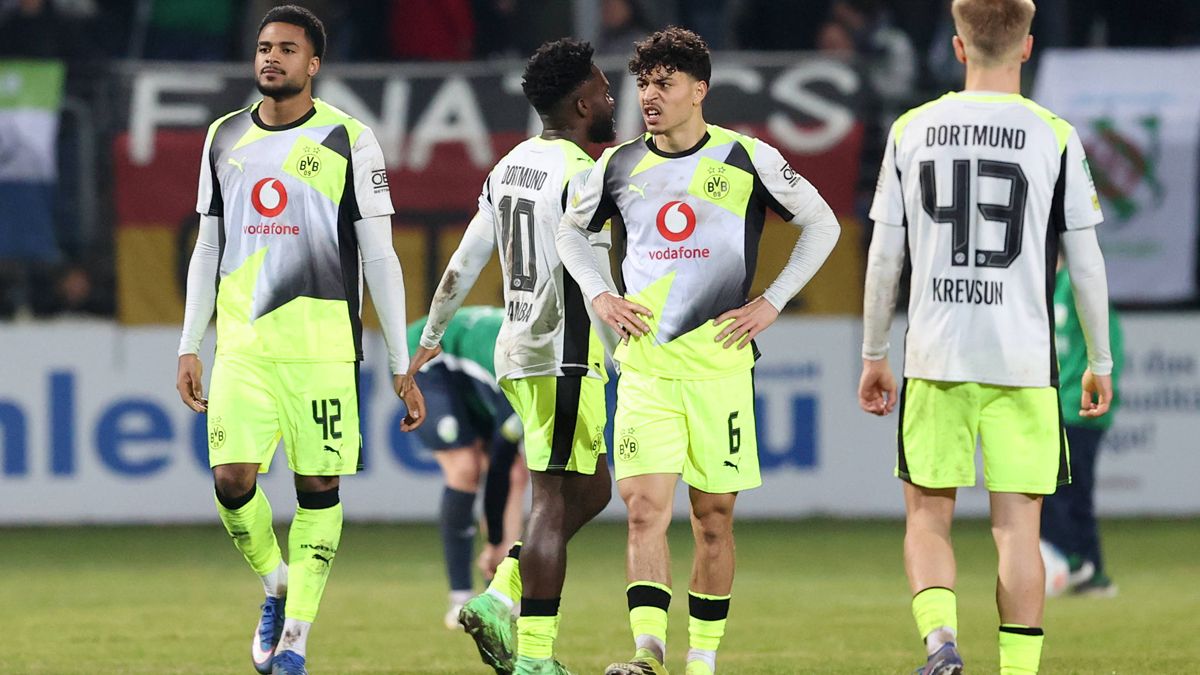
Those in charge at the Westphalian youth academy had previously gone to great lengths to avoid setting immediate promotion as a target. Yet it was easy to glean from their mostly cryptic statements that this is precisely what they are aiming for. What else could it be? A club like BVB must offer its young talents the highest possible league as a stepping stone to the professional ranks.But then, at this very early stage of the season, Tullberg suddenly spoke of a “transition year”. The shortcomings of his newly formed team had quickly become apparent to him. In his usual unsparing manner, the Dane said: “I don’t know if what we’re asking for is too much. The difference between the 3rd Division, where we had no possession and relied on long balls, and the Regional League is that we now keep possession and the opposition is just waiting for us to make mistakes. Now the lads have to play football. That’s what the manager expects too. It’s quite clear that one or two of them can’t cope with it.”Less than three weeks later, Tullberg was history at BVB. He had long been aiming for greater things and returned to his homeland to join FC Midtjylland. Having to change managers so early on amidst such upheaval, combined with the poor start to the new league, was anything but a good start for the U23s. Even though Tullberg’s assistant manager, Daniel Rios – an old acquaintance of the team – took over the role.Almost seven months have passed since Tullberg’s announcement, with 26 matchdays played in the Regionalliga. With ten games still to go for Dortmund, one thing is clear: Tullberg was right in what he said, and his assessment of the problems remains accurate to this day.Dortmund’s second team are languishing in the relegation battle – only the league leaders qualify for the 3. Liga. Lying in fourth place, the gap to the commanding leaders Fortuna Köln has grown to a whopping 15 points. And that’s not just because the U23s failed to get off the mark in the new year either, managing just two wins from six matches.Although the team has the second-best attack of all 18 sides with 55 goals, just 11 wins from 24 games and only three clean sheets are simply poor for a side relegated from the 3. Liga. In 2026, Dortmund failed to win either against 16th-placed Wuppertal or against their direct rivals from Oberhausen and Gütersloh.Consistency has so far been a foreign concept for the amateurs. The only period of stability came in early autumn, when they secured four wins in six matches. Dortmund are finding it very difficult to break down the numerous opponents who adopt a highly defensive approach. As is often the case with Niko Kovac’s first-team side, there is a lack of creativity here too when it comes to creating openings in deep defensive lines.“The fundamental objective remains the same,” NLZ director Paul Schaffran told the Ruhr Nachrichten in the winter, when BVB were just five points behind Cologne. Admittedly, once again without uttering the word “promotion”: “I’m not ruling out that we can still close this gap in the second half of the season.”The fact that this did not happen is also down to a real exodus the team had to cope with during the last transfer window. In Ben Hüning, they lost their defensive linchpin to Rot-Weiss Essen, whilst Fortuna Düsseldorf snapped up attacking midfielder Jordi Paulina. In addition, three further players left the club, and three new ones arrived."That will always be part of this team’s DNA," Schaffran made clear. "When established players and key performers leave, a gap opens up – and that is precisely the opportunity for the next generation to step into that responsibility." That may well be true in theory, but the reality and practice at BVB look quite different. The club will have long since braced itself for another year in the Regionalliga.“To create a development platform with a clear link to the first team,” said sporting director Sebastian Kehl in December 2023 regarding the new vision for Dortmund’s youth setup. Driven by the head of the youth department, Thomas Broich, the motto is now said to be: development over results.But when it comes to the second team, this approach is a bit of a catch-22. The intended link to the top is proving far more difficult to achieve when the gap is three leagues rather than just two.Of course, on the other hand, it is not a waste of time for 17- to 19-year-old prospects to gain a wealth of match experience even in the fourth tier. Yet the better stepping stone to the top is undoubtedly the third tier. It also offers greater leverage and more promising prospects for young players coming through the ranks or set to be signed.BVB must therefore, in light of the experience gained, seriously consider how to proceed with the club’s problem child. Not only were the U23s’ performances inconsistent, but so was the squad.As consistent as it was to bring top-class talents such as Mathis Albert, Samuele Inacio or – due to injury – Luca Reggiani up to the first team prematurely, the unity within the reserves suffered all the more as a result. Due to the changing line-up, the team was never able to settle and develop tactical systems to generate the dominance needed to underpin its unspoken ambitions.“You can’t achieve that within a few weeks – especially not if you’re unable to train with a large group,” Tullberg had already feared back in August. By the time the season restarts next summer, those in charge should have devised a strategy to overcome this problem and break the U23s out of their current stagnation.



Most Popular

The warriors of Israeli beach volleyball
18 hours ago