Salute replaces silence for Iran after 'message from home'
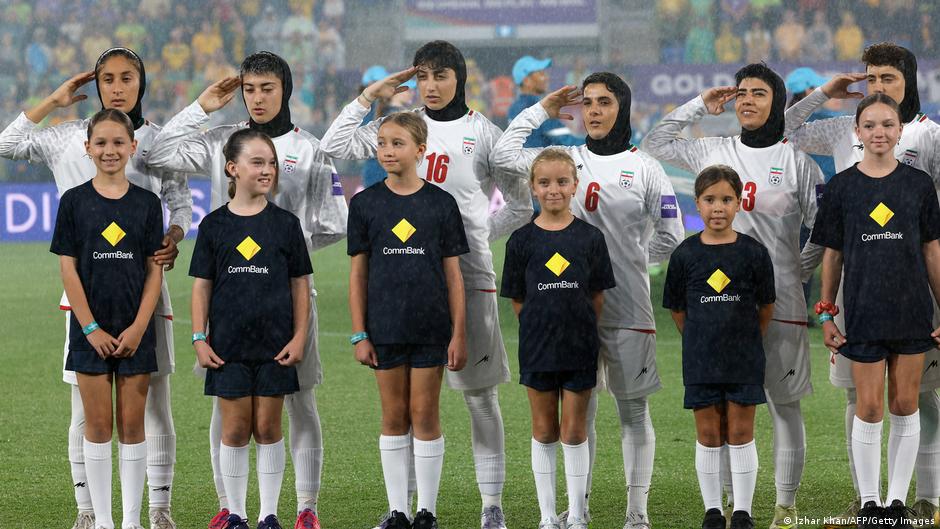
As the first notes of "Mehr-e Khavaran (Eastern Sun)" rang out at the Gold Coast Stadium, nearly 13,000 kilometers (8,000 miles) from Tehran on Australia's east coast, the Iranian women's national team raised their hands to their temples in salute. Most also appeared to sing along to their national anthem before the Asian Cup match against Australia.Three days earlier, the same players had made headlines around the world by staying silent during the playing of their anthem before their opening match against South Korea. While it's difficult to be certain, it seems likely that the players came under pressure from authorities to toe the line in the interim."Whether they were saying their prayers, or mouthing the anthem, it was clear to anyone watching on that the players had received the message from home that they needed to demonstrate symbolic solidarity with their homeland, currently under siege" Catherine Ordway, an Australian lawyer, academic and sport integrity consultant who has worked with numerous international sporting bodies, told DW.The images from Australia brought to mind Iran's men's team at the World Cup 2022. They too refused to sing their anthem in their opener against England in Qatar before mouthing it ahead of their next match against Wales. That was in the wake of anti-government protests in their home country focused on women's rights while the current disquiet relates to the US-Israeli war with Iran and the Islamic Republic's retaliation.'Brave dissent' as strain shows"Seeing the Iranian women's team choosing silence during the anthem and loosening their headscarves was a profoundly brave form of physical dissent, especially given the heightened danger for women in Iran and the regime's long history of punishing symbolic resistance," Ordway said.That has been the tightrope the squad and management have had to walk in the Asian Cup so far. They have, understandably, closed ranks to the media with only the mandatory press conferences taking place and reporters under strict instruction to only focus on the football.But Sara Didar, a 21-year-old striker, spoke of the strain the players and staff are under in the pre-match press conference on Wednesday."Obviously we're all concerned and we're sad at what has happened to Iran and our families in Iran," she said, holding back tears."I really hope for our country to have good news ahead. And I hope that my country will be strongly alive."Protestors gathered outside the Gold Coast Stadium before Thursday's match, while fans have flown the Lion and Sun flag in the stands. This was the flag used by Iranians before the Islamic Revolution of 1979. Other banners supporting human rights and backing Iran's players have also been seen in the stands, while some in attendance at the protest were opposed to Australia's support of the US-Israeli attack.Athlete persecution commonplace for IraniansSport is one of the few areas where Iranians who still reside in the country have the opportunity to present themselves to an international audience. But any show of dissent comes with real dangers.The list of recent cases is long. Perhaps most famous is that of the so-called Blue Girl Sahar Khodayari, who set herself on fire in protest at the ban on women watching football in 2019. She later died of her injuries while awaiting sentencing. Navid Afkari, one of Iran's highest-ranked wrestlers was executed in 2020 after being convicted of murdering a security guard during anti-establishment protests two years earlier. Kimia Alizadeh, Iran's only female Olympic medalist, is one of countless athletes who fled the country due to oppression."The Iranian authorities use sport to enforce moral codes and suppress dissent, even for female spectators [women have only been permitted to watch certain football matches very recently],” said Ordway."Women athletes face additional layers of surveillance and punishment because their bodies are politicized, controlled, and heavily policed."Sporting protests carry real riskAfter 4-0 and 3-0 defeats to Australia and South Korea so far, Iran's next match against the Philippines on March 8 is unlikely to offer them a path to the knockout stages. But their presence, silence and salutes have all been significant.The world will soon find out whether any other Iranian athletes will show discontent. The sole Iranian Paralympic athlete, Aboulfazl Khatibii Mianaei, is on the starting list for the men's Para cross country skiing, which starts next week while, as things stand, Iran's men will play at least three matches in the US in World Cup 2026 later this year."I would expect to see further subtle, deniable gestures from Iranian athletes on field and in press conferences, but overt protest is unlikely due to heightened surveillance and risk,” concluded Ordway."However, diaspora Iranians and international athletes may show more visible solidarity."Edited by: Chuck Penfold

Most Popular

Move over, Binfluencers. Glamour is back on the grid
18 hours ago

'She's coming back': Djokovic predicts Serena return
17 hours ago